
Application | CNC & Machine Tool
Background
A machine tool builder specializing in mid-size, high-speed CNC machining centers for the aerospace and precision automotive markets needed to redesign the axis motion system on a new 3-axis vertical machining platform. The goal was to compete with premium European machine builders on positioning accuracy and repeatability, while keeping the bill of materials cost-competitive for the North American mid-market segment.
The machine was targeted at shops running long, unattended production cycles on hardened tool steel and aerospace alloys, where dimensional consistency across a full shift mattered as much as raw speed.

The Challenge
The engineering team identified four requirements that their existing motion architecture could not fully satisfy:
- Rigidity under cutting load. Interrupted cuts in hardened materials generate significant radial and axial forces at the spindle. Any deflection in the axis guideways shows up directly as tool marks and out-of-tolerance parts.
- Thermal stability over long cycles. Ball screw drive systems generate heat during continuous high-speed moves, and thermal growth in the screw shaft directly erodes positioning accuracy over an eight- or twelve-hour unattended run.
- Contamination resistance. Coolant flood and metal chips are constant on a machining center. Guideway and screw seals needed to hold up without adding enough drag to affect servo tuning.
- Precision at speed. The platform needed rapid traverse rates competitive with premium machines, without sacrificing the repeatability required for tight-tolerance aerospace work.
The Solution
Helix worked with the machine builder's design team to specify a combination of products across the axis and auxiliary motion systems:
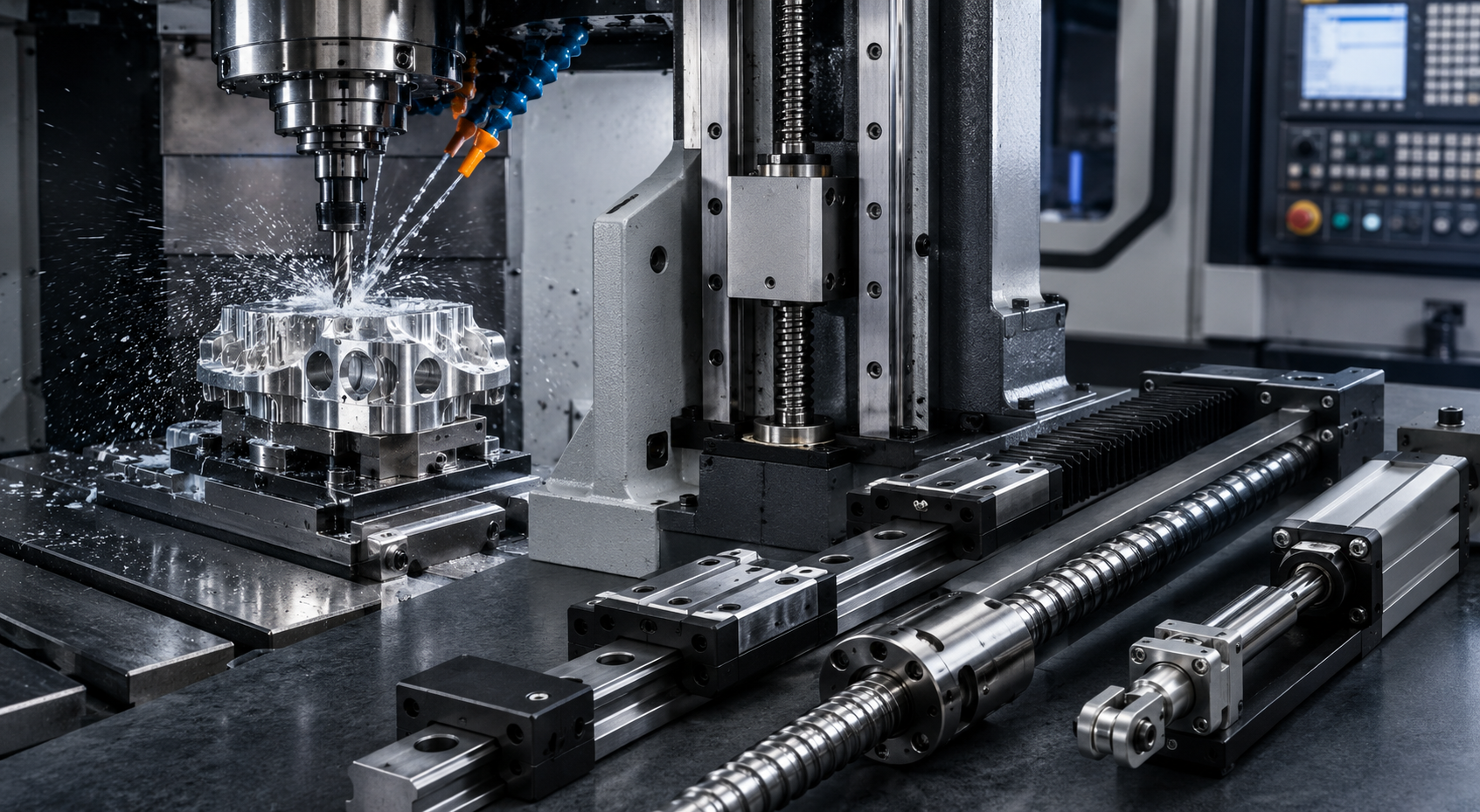
Linear guides were specified for the X and Y axis carriages, chosen for their load capacity and rigidity under the radial cutting forces typical of interrupted cuts. The guideway's contact geometry was selected to bias toward stiffness over friction reduction, since dimensional consistency under load was the priority over minimizing servo current draw.
Precision ball screws, with a preloaded double-nut configuration, were specified for the Z axis and for the X/Y drive on the higher-precision variant of the platform. The preload removed backlash that would otherwise show up as a step at direction reversals, and the lead accuracy grade was matched to the tolerance band the aerospace customers were specifying on drawings.
Linear actuators were incorporated into the automatic tool changer and the pallet-clamping subsystem, replacing a pneumatic actuation scheme that had been a recurring source of inconsistent clamping force and unplanned downtime on the builder's previous platform.
Sealed wiper and bellows options were applied across the guideways and screws to address the coolant and chip environment without introducing enough preload drag to complicate servo tuning.
"The machines that win in this market aren't necessarily the fastest on paper. They're the ones that hold tolerance on the last part of a twelve-hour run the same way they held it on the first," said Chris Nook, founder and CEO of Helix Linear Technologies. "That's a motion design problem before it's ever a controls problem, and it's where guideway stiffness and screw preload decisions really pay off."
The Results
Working from this architecture, the machine builder's platform reached its target specifications for the segment:
- Consistent part-to-part repeatability across extended unattended production runs, with no measurable drift attributable to thermal growth in the drive system
- Reduced unplanned downtime from the tool changer and clamping subsystem after the transition from pneumatic to electromechanical linear actuation
- Rapid traverse rates in line with premium machine tool competitors, without a corresponding loss of positioning accuracy
- A bill of materials that kept the platform price-competitive for its target market segment, since guideway and screw grades were matched to actual tolerance requirements rather than over-specified
Why It Matters
Machine tool builders are ultimately selling a promise about tolerance, not just speed or footprint. The axis motion system, the guideways, screws, and actuators that carry cutting loads and hold position, is where that promise is made or broken. Helix's role in projects like this one is to help engineering teams match guideway rigidity, screw preload, and actuator precision to the actual cutting loads and tolerance requirements of the application, rather than defaulting to a generic off-the-shelf motion package.
Interested in a similar motion system evaluation for your machine tool platform? Contact Helix Linear's engineering team to discuss guideway, ball screw, and actuator selection for your application.
