
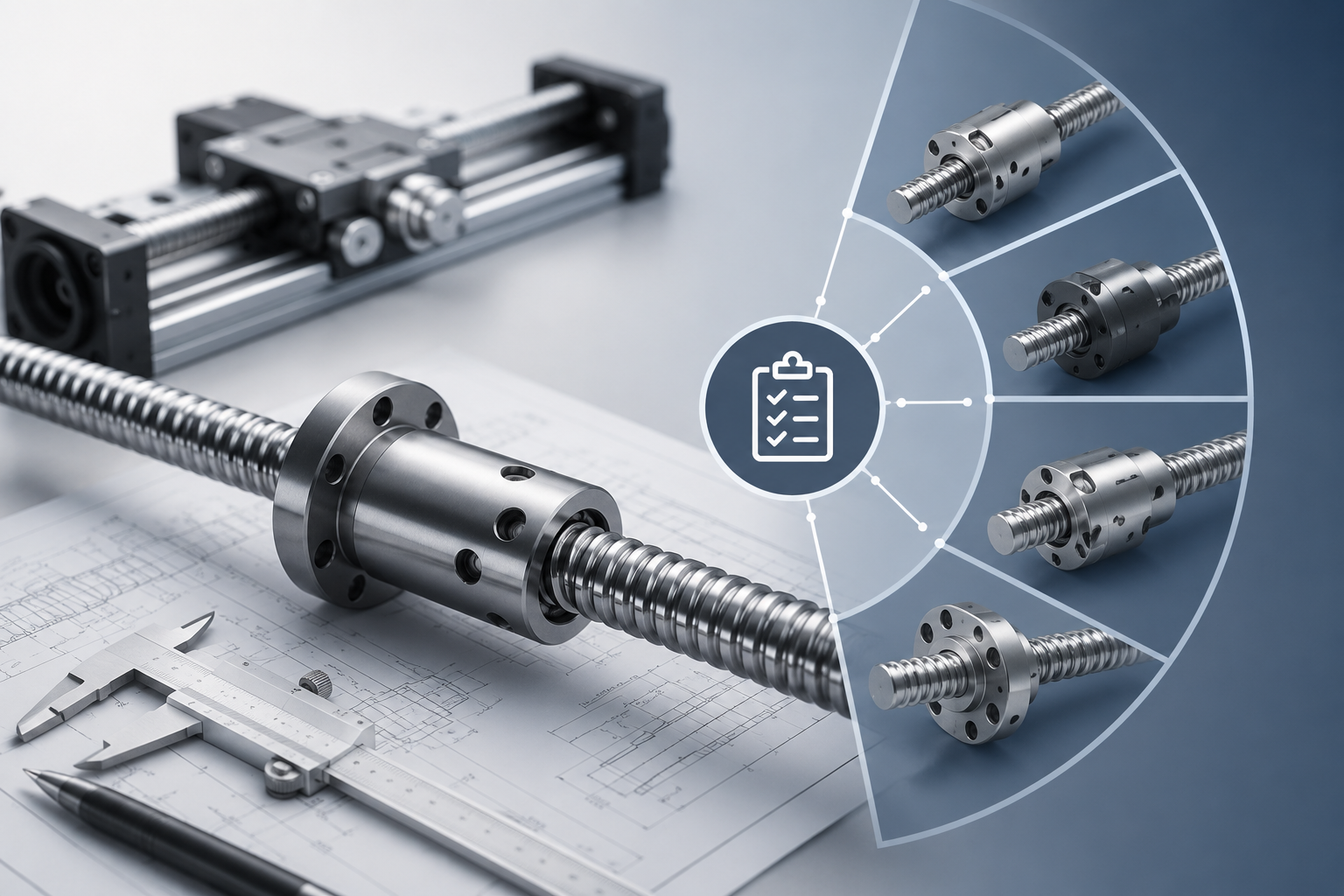
Start here when you are selecting your Ball Screw Assembly
Ball screws are available in metric and imperial sizes, standard and custom configurations, and multiple preload classes.
Getting the selection right comes down to 4 questions:
- Diameter and lead
- Rolled vs. ground precision
- Select a preload class
- Metric vs. inch.

Choosing Diameter and Lead
Selecting the proper ball screw diameter and lead is one of the most important decisions in the design process because these two specifications directly affect load capacity, speed, accuracy, stiffness, and motor sizing.
The diameter of the ball screw primarily determines its strength and rigidity. Larger diameter screws can support higher axial loads, resist deflection, and reduce the risk of buckling in applications with long unsupported lengths or heavy loads. They also provide greater stiffness, which can improve system stability and positioning accuracy. However, increasing the diameter also increases rotational inertia and generally requires a larger motor capable of delivering more torque.
The lead is the linear distance the nut travels during one complete revolution of the screw. Choosing the right lead involves balancing speed, force, and positioning resolution.
- Higher lead ball screws move the load farther with each revolution, allowing higher linear speeds while requiring fewer motor revolutions. They are often ideal for high-speed automation, packaging equipment, and long-travel applications. The tradeoff is lower mechanical advantage, meaning the motor must generate more torque, and the system provides lower positioning resolution for each motor step.
- Lower lead ball screws provide greater mechanical advantage, allowing higher thrust forces with less motor torque. They also deliver finer positioning resolution and improved control, making them well suited for precision equipment such as medical devices, semiconductor equipment, inspection systems, and laboratory automation. The tradeoff is reduced maximum linear speed because more screw revolutions are required to achieve the same travel distance.
Rather than selecting a diameter or lead independently, evaluate them together as part of the complete motion system. Begin by defining your application's required linear speed, acceleration, travel length, load, and positioning accuracy.
From there, calculate the screw speed necessary to achieve the desired travel rate, verify that it remains below the ball screw's critical speed, and confirm that the selected diameter provides sufficient stiffness and resistance to buckling. Finally, ensure the chosen lead allows the motor to deliver the required thrust without exceeding its available torque or operating speed.
Taking a system-level approach helps ensure the ball screw provides the best balance of speed, precision, efficiency, and long-term reliability while avoiding unnecessary oversizing or performance limitations.
Rolled or Ground?
While both convert rotary motion into smooth, efficient linear motion, the manufacturing process has a significant impact on accuracy, cost, lead time, and overall system performance.
Rolled ball screws are manufactured by cold-forming the threads through a precision rolling process rather than removing material. This method produces durable, work-hardened threads while offering an excellent balance of performance and cost. Rolled ball screws are the most common choice for industrial automation, packaging equipment, material handling, medical devices, and general-purpose machinery where high efficiency and repeatable motion are required without ultra-precision positioning.
Typical rolled ball screws provide lead accuracy of approximately 0.003 inch per foot (0.076 mm per 300 mm), making them suitable for the vast majority of motion control applications. They are also available in longer continuous lengths, offer shorter manufacturing lead times, and are considerably more economical than ground ball screws.
Ground ball screws undergo a precision grinding process after heat treatment, producing extremely accurate thread geometry and exceptional lead consistency. This additional manufacturing step significantly improves positioning accuracy while minimizing cumulative lead error over long travel distances.
Ground ball screws can achieve lead accuracies as tight as 0.0003 inch per foot (0.008 mm per 300 mm) which is roughly ten times more accurate than a typical rolled screw. They are commonly specified for applications such as semiconductor manufacturing equipment, coordinate measuring machines (CMMs), high-end CNC machinery, precision inspection systems, aerospace positioning equipment, and optical or laboratory instruments where even minute positioning errors can affect performance.
The tradeoff for this increased precision is higher manufacturing cost, longer lead times, and practical limitations on maximum available screw length. Because of the specialized grinding process, ground ball screws are typically produced in shorter lengths than rolled screws and require a larger investment.
For many applications, a rolled ball screw delivers more than enough accuracy while providing substantial cost savings. However, when your application demands extremely precise positioning, minimal cumulative lead error, or the highest possible repeatability, a ground ball screw becomes the preferred solution.
Rather than defaulting to the highest precision available, select the screw that matches your application's actual performance requirements. Understanding the required positioning accuracy, travel distance, load, and budget will help determine whether the added investment in a ground ball screw will provide measurable benefits over a high-quality rolled screw.
Selecting a Preload Class
Preload is one of the most important factors affecting the performance of a ball screw assembly. It refers to the intentional internal force applied between the ball nut and the screw to eliminate internal clearance. By removing this clearance, preload minimizes or completely eliminates backlash, increases system rigidity, and improves positioning accuracy and repeatability.
In a standard ball screw without preload, there is a small amount of internal clearance between the balls and the raceways. While this clearance allows the assembly to operate with minimal friction, it can also permit slight axial movement when the direction of travel changes. In applications requiring precise positioning, this movement (commonly referred to as backlash) can reduce accuracy and repeatability.
A preloaded ball nut removes this internal play by applying a controlled axial force to the ball bearings. This creates continuous contact between the balls, screw, and nut raceways, resulting in a much stiffer drive system. The increased rigidity helps maintain accurate positioning under changing loads, reduces vibration, and improves overall motion quality, particularly during rapid acceleration, deceleration, or frequent reversing.
The benefits of preload include:
- Reduced or eliminated backlash
- Increased axial stiffness
- Improved positioning accuracy and repeatability
- Better response during direction changes
- Reduced vibration and smoother motion under dynamic loads
These advantages make preloaded ball screws the preferred choice for applications such as CNC machinery, semiconductor manufacturing equipment, medical devices, robotics, aerospace positioning systems, optical equipment, and other precision automation systems.
However, preload is not without tradeoffs. Because the balls remain under constant contact pressure, a preloaded assembly generates more friction than a non-preloaded design. This additional friction increases the torque required to drive the screw, produces more heat during operation, and can reduce operating efficiency. Heavier preload levels also place greater stress on the rolling elements, which may reduce service life if the application does not truly require the additional stiffness.
For this reason, preload should always be matched to the application's performance requirements rather than simply selecting the highest preload available.
- Non-preloaded ball screws provide the lowest friction, highest mechanical efficiency, and longest potential service life. They are well suited for applications where slight backlash is acceptable, such as material handling, conveyors, packaging equipment, and general industrial automation.
- Light preload offers an excellent balance between efficiency and precision. It significantly reduces backlash while maintaining relatively low friction, making it a popular choice for many factory automation, inspection, laboratory, and motion control applications.
- Medium to heavy preload is reserved for demanding precision applications where maximum rigidity and repeatability are critical. These configurations are commonly used in CNC machining centers, coordinate measuring machines (CMMs), precision grinding equipment, semiconductor manufacturing, and other systems where even microscopic deflection can affect part quality or process accuracy.
The ideal preload class depends on the complete motion system, including load magnitude, duty cycle, travel speed, expected service life, positioning requirements, and available motor torque. An experienced motion system engineer will balance these factors to select a preload level that delivers the required performance without introducing unnecessary friction or reducing component life.
.
.
Understanding Helix Preload and Backlash Options
Unlike some motion component manufacturers that categorize preload into named classes such as "light," "medium," or "heavy," Helix Linear Technologies specifies preload and backlash independently. This provides engineers with greater flexibility to optimize a ball screw assembly for the specific performance requirements of their application.
For inch ball screw assemblies, adjustable preload is available on select ball nut designs. Rather than selecting from predefined preload classes, preload is configured as a percentage of the ball screw's dynamic load rating:
-
10% of the dynamic load rating – Recommended for most precision applications, providing an excellent balance of rigidity, positioning accuracy, friction, and service life.
-
Up to 30% of the dynamic load rating – Available for applications requiring maximum stiffness and minimal backlash, although higher preload increases friction, drive torque requirements, and wear.
Because preload is specified numerically rather than by named categories, engineers can select the amount of preload that best matches the application's performance objectives.
It is also important to distinguish preload from backlash, as the two are often confused. Helix part numbers identify the backlash specification, not the preload level. Available backlash designations include:
-
S – Standard Backlash: Less than 0.004 in
-
R1 – Reduced Backlash: Less than 0.001 in
-
R2 – Reduced Backlash: Less than 0.002 in
-
R3 – Reduced Backlash: Less than 0.003 in
These designations describe the allowable internal clearance of the assembled ball screw rather than the amount of preload applied.
For inch products, preload capability is determined by the ball nut construction itself. Helix offers several nut configurations, including:
-
Single Circuit Ball Nut
-
Double Circuit Ball Nut
-
Double Circuit (or Four Circuit) Ball Nut with Adjustable Preload
Only the adjustable preload nut designs allow preload to be configured within the recommended operating range.
The metric ball screw product line follows a different approach. Rather than offering adjustable preload options, metric ball nuts are manufactured with specified backlash values that are listed directly in the product tables. Depending on the part number, these backlash values typically range from approximately 0.05 to 0.07 mm, providing consistent, predictable performance without requiring preload adjustment. Metric ball nuts are generally supplied as fixed-backlash, single-nut assemblies, making selection straightforward while still providing the precision required for a wide range of industrial automation and motion control applications.
When choosing a ball screw assembly, engineers should evaluate both backlash requirements and system rigidity rather than focusing solely on preload. Selecting the appropriate nut construction, backlash specification, and preload configuration helps ensure the motion system achieves the desired balance of accuracy, stiffness, efficiency, and long-term reliability.
Metric or Inch?
While the performance differences between the two are minimal, choosing the correct standard early in the design process can simplify integration, reduce machining costs, and improve overall system compatibility.
In most cases, the decision is driven by the rest of the machine. If your equipment is designed using metric components, a metric ball screw is typically the best choice. Likewise, if the machine is built around imperial dimensions, an inch ball screw will integrate more naturally with the surrounding mechanical components.
Metric ball screws are commonly used in equipment designed for international markets and industries that follow ISO standards, including many applications in Europe and Asia. They pair seamlessly with metric bearings, couplings, shafts, fasteners, and mounting hardware, making them a natural fit for globally sourced equipment and many modern automation systems.
Inch ball screws are often preferred for machinery designed and manufactured in the United States. They integrate easily with imperial mechanical components, standard bearing sizes, and NEMA motor frames commonly found in North American industrial equipment. For companies maintaining or upgrading existing machinery, remaining within the imperial system also eliminates the need for custom adapters or mixed-dimension components.
While it is technically possible to combine metric and imperial components, doing so can introduce unnecessary complexity during manufacturing and assembly. Mixing standards may require custom-machined adapters, special couplings, non-standard mounting hardware, or additional inventory, all of which can increase cost and extend production time.
When selecting a ball screw, it is also important to consider the entire motion system, not just the screw itself. The ball screw should be compatible with the motor, coupling, bearing supports, linear guides, mounting plates, and other drive components to ensure straightforward installation and reliable long-term performance.
Helix Linear Technologies manufactures both metric and inch ball screw assemblies as standard product lines, complete with matching ball nuts and motion components. In addition to catalog products, our engineering team can design and manufacture custom ball screws, custom machined ends, and application-specific assemblies when standard sizes do not meet your performance or packaging requirements. This flexibility allows engineers to optimize their design while maintaining compatibility with the rest of the motion system.
If you have specific questions, our Application Engineers here at Helix Linear Technologies can help. Just click the chat button below or contact us for assistance.
