
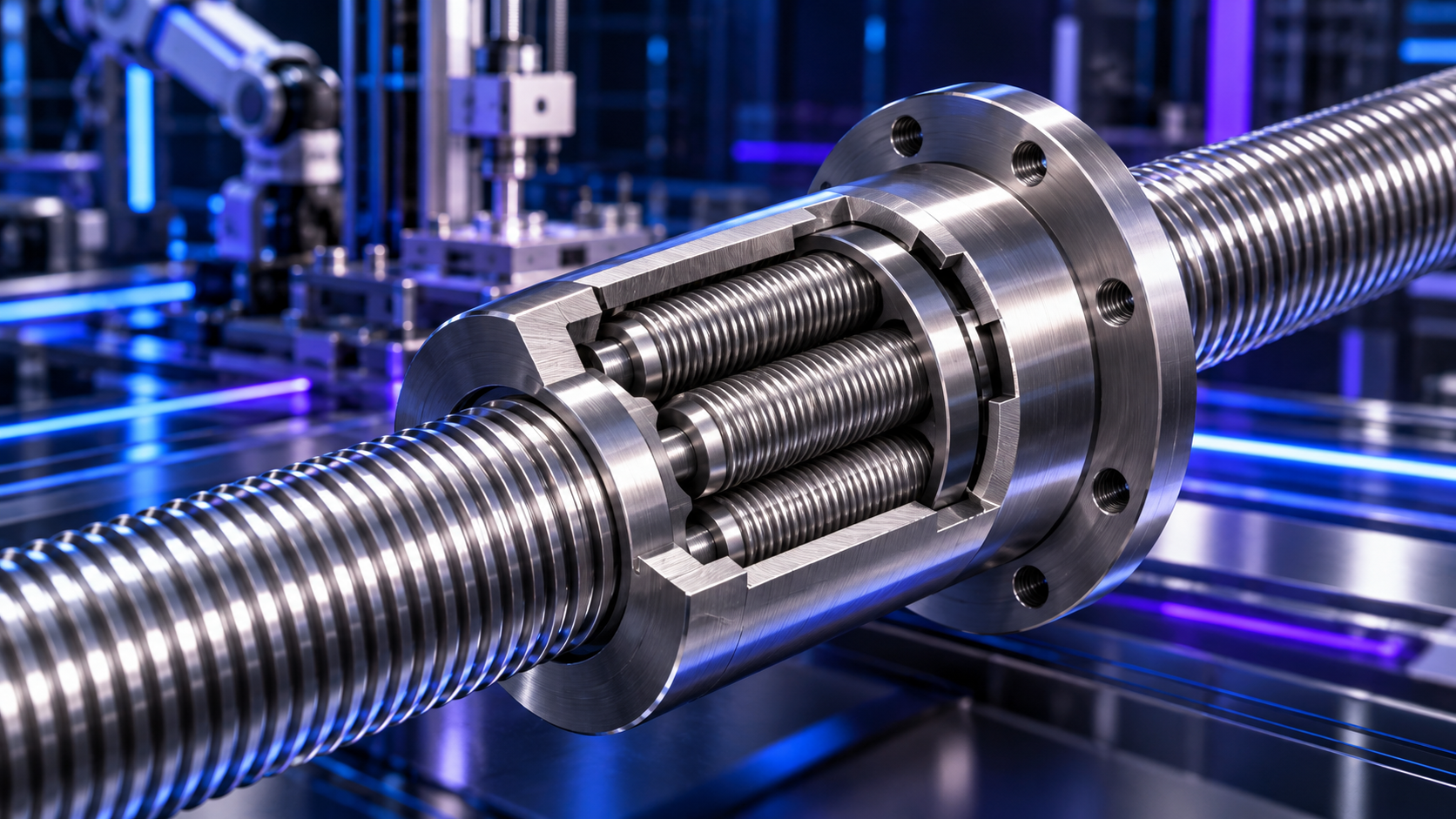
Advantages of Roller Screw Automation
Automation systems are being asked to move heavier loads, hold tighter positions, and run longer with less downtime. A roller screw is often chosen when a screw-driven axis needs more stiffness, load capacity, and service life in a small package.
This article explains how roller screws support modern automation, where they fit best, and what engineers should weigh when comparing actuator options.

Why are roller screws valuable in automation?
Roller screws are valuable in automation because they turn rotary motion into linear motion with high contact efficiency, strong load sharing, and high rigidity. Instead of sliding contact, a roller screw uses several threaded rollers between the screw and nut, spreading force across many contact points. For automated equipment, that can mean smoother motion, better consistency, and a more durable axis in tough duty cycles.
A roller screw linear actuator is especially useful when an application needs the control of an electric actuator but the force density often linked to hydraulic or pneumatic systems. By pairing a motor, feedback device, and roller screw actuator, machine builders can create precise linear motion without fluid power gear. Roller screws are useful in various systems like assembly, packaging, and robotics, where precision and reliability are crucial.

The basic mechanics behind roller screw performance
A roller screw design looks simple from the outside, but its performance comes from the way the internal parts share load. The screw shaft has a fine thread shape. The nut surrounds the screw. Between them, threaded rollers engage both parts and rotate as the screw or nut turns.
This geometry creates several gains. Because several rollers carry the load at the same time, the assembly can handle heavy axial force without a large package. The rolling contact also supports efficient motion, which helps cut heat compared with sliding systems. In applications where an axis speeds up, slows, reverses, or holds position often, that difference can matter.
People also know roller screws for their stiffness. Stiffness affects how much an axis bends under load, how fast it settles after motion, and how well a control system can hold position. In automation, that can affect part quality, cycle consistency, tool alignment, and overall machine stability.
Roller screws compared with common linear motion options
No actuator technology is right for every machine. The value of a roller screw depends on what the axis must do, how often it runs, and what the site demands. Still, a few comparisons help explain why engineers often move toward roller screw technology for higher-performance automation.
- Compared with ball screws: Ball screws are widely used and can work well, but roller screws usually offer more load capacity and stiffness in a similar space. They are often chosen when ball screw life, shock resistance, or force density becomes a limit.
- Compared with lead screws: Lead screws are simple and low cost, but they rely more on sliding contact. For high-duty automation, a roller screw actuator can give better efficiency, speed potential, and service life.
- Compared with hydraulic cylinders: Hydraulics can deliver high force, but they need fluid, pumps, valves, hoses, and leak control. A planetary roller screw actuator can offer precise electric control in a cleaner, more programmable package.
- Compared with pneumatic cylinders: Pneumatics are useful for simple moves, but they are harder to control with precision. Roller screw systems are better for jobs that need control of force, position, and speed.
The key is not to treat roller screws as a universal upgrade. They make the most sense when the machine benefits from their strengths: high load, compact size, frequent cycling, precise positioning, and long service life.
Planetary roller screw technology and its role
A planetary roller screw uses rollers arranged around the screw in a planetary pattern. As the screw turns, the rollers rotate and orbit in a controlled relationship with the nut and screw threads. This setup creates a strong path for axial force while keeping linear motion accurate.
The term planetary roller screw is often used broadly, but details vary by maker, series, and job. Some designs focus on very high dynamic load capacity. Others stress compact size, high speed, smooth motion, or electric cylinder integration. When comparing planetary roller screw manufacturers, look beyond the headline load rating and check the full actuator need.
A planetary roller screw actuator can be supplied as a screw and nut assembly or as part of a fully built electromechanical unit. Integrated versions may include a housing, bearings, grease features, motor mount, sensors, and guards. For OEMs, that can cut design work and make installation easier, especially when the supplier gives application support.
What is a recirculating roller screw?
A recirculating roller screw is a roller screw type in which the rollers follow a return path so they keep cycling through the load zone. This design is often tied to jobs that need high precision, high load capacity, and a compact build. The return flow helps the system keep controlled contact between the threaded parts while supporting demanding linear motion.
In practice, engineers may choose a recirculating roller screw when they need a compact actuator with high mechanical performance. It can fit tightly packed machines, test gear, and precision automation where load, life, and motion quality must be balanced. As with any roller screw design, proper sizing, grease, mounting, and alignment remain key.
The choice between a standard planetary style, an inverted style, or a recirculating version should be based on the motion profile, not on word choice alone. Stroke length, speed, load direction, site conditions, free space, and service needs all shape the best fit.
Benefits that matter on the plant floor
The strongest case for roller screws is not just mechanical neatness. What they help a machine do day after day. In automation, the gains often show up in cycle consistency, control, and less tradeoff between force and precision.
Higher force in a small axis
Many automation systems have little room for actuators, tooling, guards, and nearby machine parts. Roller screws can help designers deliver high axial force without a much larger actuator size. This is useful in presses, clamps, grippers, joining systems, and vertical axes where both space and force matter.
Better control of motion and force
When paired with servo motors and feedback, a roller screw linear actuator can support set motion profiles. Operators and controls engineers can adjust speed, position, ramp rate, dwell, and force settings through the machine control system. That flexibility helps when a line handles many part types or when process quality depends on controlled movement rather than simple end-to-end travel.
Durability under hard cycles
Automation equipment often runs the same motion cycle for long periods. Because a roller screw spreads load across multiple rolling parts, it can fit high-duty jobs when sized and maintained well. This can help reduce early wear in axes that see frequent starts, stops, reversals, or steady force.
Clean electric integration
Many makers are replacing fluid power in selected axes to simplify care and improve control. A roller screw actuator supports that shift by joining mechanical strength with electric actuation. It can reduce reliance on hydraulic power units or compressed air systems where those tools are not otherwise needed.
Application areas where roller screws stand out
Roller screws appear in many types of automated machinery because they solve a common problem: how to create controlled linear force in a small space. They are especially useful where equipment must move in a steady way under heavy load.
Common use cases include:
- Pressing and joining: Controlled pressing, staking, riveting, insertion, and assembly work can benefit from repeat force and position control.
- Test and measurement equipment: Load frames, fatigue systems, and product test stations often need precise, repeat motion under changing force.
- Robotics and end effectors: Compact, high-force linear movement can support gripping, clamping, lifting, or tool placement.
- Packaging and converting: Fast, repeatable linear axes can help with cutting, sealing, tensioning, and format changes.
- Industrial positioning systems: Heavy slides, vertical lifts, and adjust axes may use roller screws where stiffness and load capacity are priorities.
In each case, the actuator should be judged as part of the whole system. Motor sizing, gearbox choice, bearings, guides, grease, controls, and safety strategy all affect the result.
How should you evaluate roller screw manufacturers?
You should evaluate roller screw manufacturers by looking at engineering support, product range, design docs, custom options, quality checks, and experience with applications like yours. A catalog load rating is only one part of the choice. The right supplier should connect the motion profile, environment, duty cycle, and packaging limits to a realistic actuator choice.
When reviewing planetary roller screw manufacturers, consider these questions:
- Can they support both component-level roller screws and complete actuator assemblies?
- Do they give clear guidance on load, speed, stroke, lubrication, mounting, and expected duty cycle?
- Are multiple builds available, such as standard, inverted, or recirculating roller screw options?
- Can the roller screw design be adapted for unusual space limits, environmental needs, or integration needs?
- Is technical support available early enough to prevent oversizing, undersizing, or avoidable redesign?
A strong supplier relationship matters because roller screws are often used in critical axes. Early work together can help cut risk, especially when replacing hydraulics, upgrading from ball screws, or building a new machine platform.

Design checks before you specify a roller screw
Selecting a roller screw is not just a matter of picking the highest load rating. The most reliable designs start with a clear motion profile and real operating conditions. Before specifying a roller screw actuator, engineers should define the max and typical loads, stroke, speed, ramp rate, duty cycle, orientation, and needed positioning accuracy.
A practical checklist includes:
- Load direction: Confirm whether the axis sees tension, compression, reversing loads, shock, or side loading.
- Stroke and speed: Make sure the screw length, critical speed, and bearing layout match the motion need.
- Mounting alignment: Protect the screw from side loads by using proper linear guides and accurate mounting surfaces.
- Lubrication plan: Choose grease intervals and methods that fit the site and access points.
- Environmental exposure: Consider dust, washdown, temperature, debris, vibration, and dirt.
- Control strategy: Match the actuator to the motor, drive, feedback, and safety setup.
- Maintenance access: Design the machine so inspection and service can happen without extra disassembly.
These details shape performance as much as the screw itself. A well-chosen roller screw in a badly aligned or under-supported system may not deliver the hoped-for gain. By contrast, a properly built actuator can become one of the most dependable parts of the machine.
The future of roller screws in electric automation
As more makers look for precise, efficient, and programmable motion, roller screws are becoming a natural fit for high-performance electric axes. They help bridge the gap between simple electric linear actuators and old-style fluid power systems. For machine builders, that can mean cleaner layouts, easier recipe changes, and tighter links with digital control.
The rising interest in electric actuation also makes actuator choice more strategic. Instead of asking whether a roller screw is stronger than another screw type on its own, engineers are asking how the full axis supports throughput, quality, maintenance, and flexibility. That wider view is where roller screws often prove their value.
Helix Linear roller screw offerings
Helix Linear Technologies supplies precision roller screw components built for high load, high duty cycle, and high precision applications. Our roller screws are designed to be integrated into the actuators and machines our customers engineer and build, giving design teams the load capacity and stiffness they need without forcing a one-size-fits-all package.
The Helix roller screw lineup covers the main configurations discussed in this article, along with supporting components that help complete the axis:
- Standard Roller Screw (SRS): A planetary design suited to heavy-duty axes such as presses, jacks, and structural test equipment, where high load capacity and long travel life are priorities.
- Ultra-High-Capacity Roller Screw (URS): Built for applications that push axial load requirements beyond what a standard roller screw can support in the same envelope.
- Inverted Roller Screw (IRS): The nut rotates while the screw translates, which helps in tight spaces or where the linear member must stay rotationally fixed.
- Recirculating Roller Screw (RRS): Rollers recirculate through the nut in a closed loop, supporting long stroke lengths combined with high load capacity.
- Differential Roller Screw (DRS): An option for applications with specialized lead and resolution requirements.
- Roller screws with HRB (HRA-S and HRA-I): Standard and inverted roller screw versions paired with integrated bearing arrangements to simplify mounting and assembly.
- Support bearing units (HHF and SBU): Support bearing units with HRB or ACCB configurations to help maintain alignment and carry loads properly at the screw ends.
Because every application places different demands on load, speed, stroke, environment, and accuracy, Helix application engineers work directly with design teams to select or specify the right roller screw and nut configuration. That early collaboration helps prevent oversizing, undersizing, and redesign, especially when replacing hydraulics or moving up from a ball screw. Helix is AS9100 certified, which supports the quality expectations of aerospace, defense, and other demanding markets where roller screws are commonly specified.
You can explore the full lineup and download CAD files on the Helix roller screws page.
Final takeaway
Roller screws give automation designers a strong way to combine force, precision, stiffness, and durability in a compact linear motion package. Whether the best fit is a planetary roller screw, a recirculating roller screw, or a fully built planetary roller screw actuator, the real gain comes from matching the design to the application. Start with the motion needs, involve qualified roller screw manufacturers early, and specify the complete actuator system around the work the machine must do.
Q&A
Question: When should an engineer choose a roller screw instead of a ball screw?
Short answer: A roller screw is worth considering when a ball screw may not give enough load capacity, stiffness, shock resistance, force density, or service life for the job. Ball screws can work well in many automation systems, but roller screws are often better for compact axes that must handle high loads, frequent cycling, precise positioning, or hard duty cycles.
Question: Are roller screws a direct replacement for hydraulic or pneumatic cylinders?
Short answer: Not always, but they can replace fluid power in selected axes where electric control, clean operation, set motion, and lower maintenance are priorities. A roller screw actuator can provide high force with precise control of position, speed, and force settings, without pumps, valves, hoses, compressed air systems, or leak control. The best choice depends on the full motion profile, force need, site, and machine setup.
Question: What is the difference between a planetary roller screw and a recirculating roller screw?
Short answer: A planetary roller screw uses rollers arranged around the screw in a planetary pattern, with the rollers rotating and orbiting in a controlled relationship with the nut and screw threads. A recirculating roller screw guides the rollers through a return path so they keep cycling through the load zone. Both can support high-performance linear motion, but the right choice depends on stroke, speed, load direction, free space, precision needs, and service needs.
Question: Why is proper integration as important as selecting the roller screw itself?
Short answer: Roller screw performance depends on the full actuator system, not only the screw rating. Motor sizing, bearings, guides, grease, mounting alignment, feedback, controls, environmental protection, and maintenance access all affect reliability and accuracy. A high-quality roller screw may underperform if it is exposed to side loading, poor alignment, weak lubrication, or a poor control setup.
Question: What information should be defined before contacting roller screw manufacturers?
Short answer: Engineers should define the motion profile and operating conditions as clearly as possible, including maximum and typical loads, stroke, speed, ramp rate, duty cycle, orientation, accuracy needs, load direction, environmental exposure, lubrication needs, and maintenance access. Sharing this data early helps manufacturers recommend a realistic actuator design and reduces the risk of oversizing, undersizing, or redesign.
If you have further questions about linear actuators, please reach out to our application engineers here at Helix. We're happy to help!
