
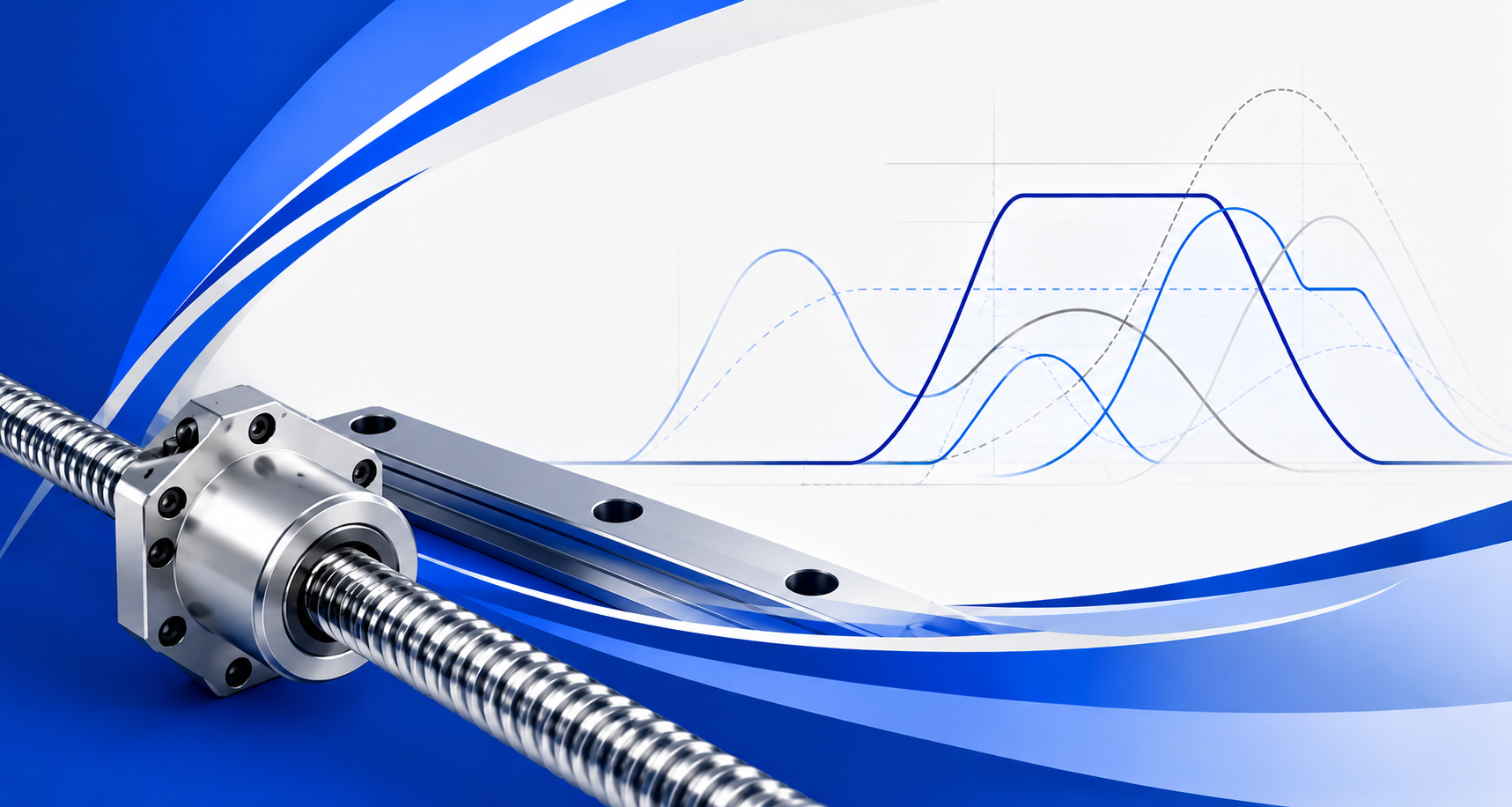
Motion Profile Calculators: Why Motion Tuning Matters in Linear Motion System Design
In linear motion system design, engineers often focus heavily on component selection with lead screws, ball screws, motors, guides, and actuators. However, one of the most important performance factors is frequently overlooked early in the design process: the motion profile itself.
The way a system accelerates, travels, and decelerates can significantly impact positioning accuracy, vibration, cycle time, mechanical wear, and overall machine performance.
To help engineers better visualize and compare different motion strategies, we at Helix Linear Technologies developed a new interactive Motion Profile Calculator:
This tool allows users to configure and analyze motion behavior using multiple motion profile types commonly used in automation and precision motion applications.
What Is a Motion Profile?
A motion profile defines how a system moves from one position to another over time. Instead of instantly moving at full speed, the system follows a controlled sequence of acceleration, velocity, and deceleration.
Motion profiles are used to:
-
Improve positioning accuracy
-
Reduce vibration and resonance
-
Optimize cycle times
-
Minimize mechanical shock
-
Improve system reliability
-
Reduce wear on motors and mechanical components
In many precision systems, the motion profile can be just as important as the hardware itself.
Common Motion Profile Types
Trapezoidal Motion Profiles
A trapezoidal profile is one of the most common motion control strategies used in industrial automation.
The motion consists of three stages:
-
Acceleration
-
Constant velocity
-
Deceleration
Because the system reaches and maintains maximum velocity, trapezoidal profiles are often used in applications where reducing total travel time is important.
Common applications include:
-
Pick-and-place systems
-
CNC machinery
-
Material handling systems
-
Industrial automation equipment
Triangular Motion Profiles
Triangular motion profiles accelerate and then immediately decelerate without entering a constant velocity phase.
These profiles are commonly used when:
-
Travel distances are short
-
Smooth transitions are preferred
-
The system cannot reach maximum velocity before stopping
Triangular profiles can help reduce mechanical stress in short-distance precision movements.
Why Motion Profiles Matter
Vibration and Resonance
Aggressive acceleration rates can introduce vibration into a system. This becomes especially important in applications involving:
-
Optical systems
-
Medical devices
-
Semiconductor equipment
-
High-speed automation
-
Precision inspection systems
Excessive vibration can reduce positioning accuracy, increase settling time, and negatively impact product quality.
Selecting the proper motion profile helps create smoother movement and more stable system behavior.
Cycle Time Optimization
Faster acceleration often reduces cycle time, but there are tradeoffs.
Increasing acceleration too aggressively may lead to:
-
Higher motor torque requirements
-
Increased heat generation
-
Greater mechanical loading
-
Reduced component life
-
Instability or overshoot
The ideal motion profile balances speed, stability, and long-term reliability.
Mechanical Stress and Wear
Motion profiles directly affect the forces experienced by:
-
Lead screws
-
Ball screws
-
Bearings
-
Motors
-
Couplings
-
Linear guides
Smooth acceleration and deceleration can reduce shock loading and extend component life, especially in high-cycle automation systems.
Motion Profiles in Linear Motion Applications
Motion profile optimization is widely used across many industries, including:
Medical Devices
Smooth motion is critical in:
-
Imaging systems
-
Diagnostic equipment
-
Laboratory automation
-
Surgical robotics
Excess vibration or sudden movement can negatively affect precision and repeatability.
Semiconductor Manufacturing
Semiconductor systems often require highly controlled motion to minimize vibration and contamination risks in precision processes such as:
-
Wafer handling
-
Inspection stages
-
Lithography systems
-
Metrology equipment
Aerospace and Defense
Motion profile tuning is important in aerospace systems where reliability, precision, and controlled actuation are essential.
Applications may include:
-
Antenna positioning systems
-
UAV actuation
-
Guidance systems
-
Precision control mechanisms
Factory Automation
In automation systems, engineers frequently optimize motion profiles to improve throughput while reducing wear and improving repeatability.
Applications include:
-
Pick-and-place systems
-
Packaging equipment
-
Conveyor automation
-
Robotic positioning systems
Explore the Motion Profile Calculator
Helix Linear’s Motion Profile Calculator allows engineers to visualize and compare motion behavior by adjusting parameters such as:
-
Velocity
-
Acceleration
-
Distance
-
Motion profile type
-
Timing behavior
The calculator can help engineers better understand motion tradeoffs during the design and optimization process.
Explore the tool here:
Helix Linear Motion Profile Calculator
Linear Motion Components for Precision Motion Systems
While motion profiles control system behavior, component selection remains equally important.
Helix Linear Technologies manufactures precision linear motion components used in demanding applications across automation, medical, semiconductor, aerospace, and industrial markets, including:
-
Lead Screws
-
Ball Screws
-
Linear Actuators
-
Electric Cylinders
-
Linear Guides
-
Anti-Backlash Nuts
-
Precision Motion Assemblies
Our engineering team works closely with customers to help optimize both component selection and motion system performance.
Additional Engineering Resources
Explore more engineering tools and resources from Helix Linear Technologies:
