
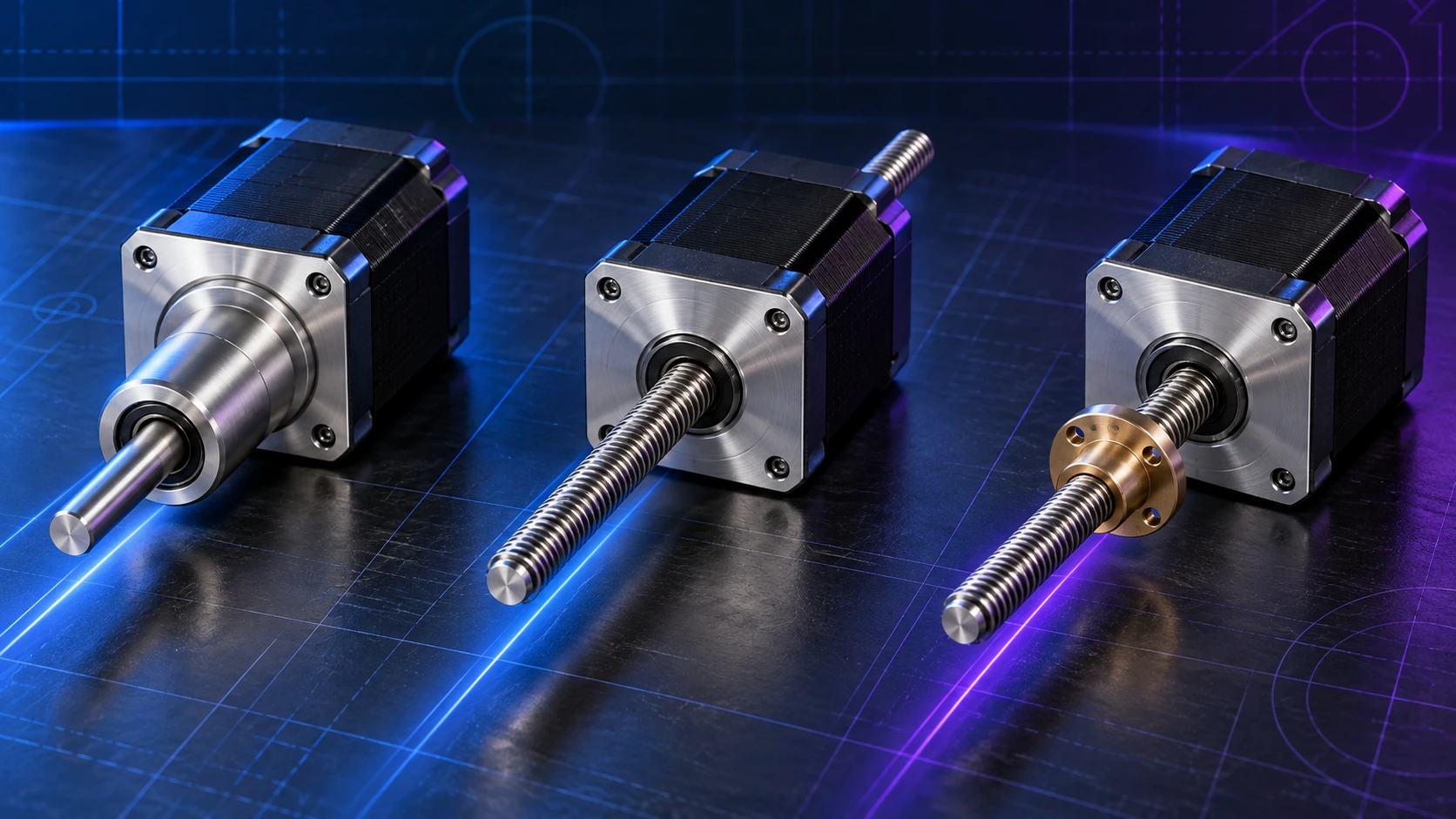
Start with three decisions
A stepper motor linear actuator combines a hybrid stepper motor and a precision lead screw into one compact unit that delivers controlled, repeatable linear motion. Helix Linear Technologies designs and manufactures these actuators in Beachwood, Ohio, for OEMs building medical devices, semiconductor equipment, laboratory automation, robotics, and aerospace systems.
If you are specifying an actuator for a new design, three decisions shape nearly everything else:
- Configuration: captive, non-captive, or external.
- Motor frame size: how much force you need in how much space.
- Lead screw: how you trade speed against resolution and holding behavior.
This guide walks through each decision, then covers duty cycle, stroke, and mounting. If you are new to how linear actuators convert rotary motion into linear travel, start with our overview, How Does a Linear Actuator Work?

Captive, non-captive, or external?
The right configuration depends on two questions: does your design already provide anti-rotation and guidance, and how much stroke do you need relative to the space available?
|
Configuration |
How it moves |
Anti-rotation |
Best fit |
|---|---|---|---|
|
A shaft extends and retracts from the motor body |
Built in |
Short strokes where you want a self-contained push-pull unit with no external guide |
|
|
The lead screw passes through the motor, which drives an internal nut |
Supplied by your design (the screw must be held from rotating) |
Longer strokes in a compact footprint, where the screw can be fixed to the moving load |
|
|
A lead screw is attached to the motor shaft, and an external nut travels along it |
Supplied by your design (usually a linear guide or slide) |
Long strokes and carriage-style motion, often paired with a linear guide |
Captive actuators are the simplest to integrate. Anti-rotation is handled inside the unit, so the shaft can push or pull a load directly. That makes them a common choice for fluid dispensing, valve actuation, and diagnostic equipment where space is tight and stroke is short. Explore Helix captive stepper motor actuators.
Non-captive actuators let the screw travel through the motor. Because the screw must be restrained from rotating, they work best when the load or frame already holds it in place. The payoff is longer travel without a larger motor body.
External actuators turn the lead screw itself, and the nut does the traveling. They are the natural choice when the design already includes a guide rail or slide, or when stroke length is the priority. For fully integrated guide-and-actuator assemblies, see Helix linear slides.
Sizing the motor frame
NEMA frame size sets the actuator's footprint and largely sets its available thrust. Larger frames deliver more force, but they also add width, weight, and power draw. The goal is the smallest frame that meets your peak force requirement with margin.
Size for the worst case in the motion, not the average load. Include the load itself, friction in the mechanism, acceleration, and any angle or leverage between the actuator and the load. Then add a safety factor appropriate to the application.
Helix offers nearly 2,000 linear actuator configurations across five NEMA frame sizes, each available with single or double stack motors:
|
NEMA frame |
Faceplate size |
Motor stack options |
Typical fit |
|---|---|---|---|
|
NEMA 8 |
0.8 in (20 mm) |
Single, double |
Most compact designs: handheld and benchtop medical devices, small lab instruments |
|
NEMA 11 |
1.1 in (28 mm) |
Single, double |
Compact positioning where space is tight but more thrust is needed than NEMA 8 |
|
NEMA 14 |
1.4 in (35 mm) |
Single, double |
Mid-range thrust in a still-compact package |
|
NEMA 17 |
1.7 in (42 mm) |
Single, double |
The most widely configured frame: general automation, robotics, semiconductor equipment |
|
NEMA 23 |
2.3 in (57 mm) |
Single, double |
Highest thrust in the line, for heavier loads and larger machines |
A double stack motor adds length rather than width, delivering more torque, and therefore more thrust, within the same faceplate footprint. Encoder options (500 and 1,000 CPR) are available for closed-loop position verification. Browse all Helix linear actuators.
For motor torque, speed, and inertia calculations, use the Helix Stepper Motor Calculator.
Choosing the lead screw
The lead screw converts each motor step into linear travel, so its lead (the distance traveled per revolution) decides how speed, resolution, and force trade off against each other.
- Shorter lead: finer resolution per step and more thrust from the same motor, at lower linear speed.
- Longer lead: faster travel per revolution, with coarser resolution and less thrust.
Start from the resolution and speed your application requires, then choose the lead that satisfies both. Microstepping can refine resolution further, but lead remains the primary design lever.
Holding position and backdriving. A lead screw with a fine lead and higher friction tends to resist backdriving, meaning a load cannot easily push the nut back when power is removed. A coarser, more efficient lead may backdrive. If the load must stay in place with the motor de-energized, especially in a vertical axis, confirm holding behavior with engineering or add a brake rather than assuming the screw will hold.
Nut material. Helix's self-lubricating polymer nuts run quietly and need no added lubrication, which suits medical and laboratory equipment. Bronze nuts handle heavier loads but require lubrication.
Run the numbers for your load case with the Helix Lead Screw Calculator.
Duty cycle and service life
Stepper motors produce heat whenever current flows, including while they hold position. That makes duty cycle, the share of time the actuator is energized versus resting, one of the biggest drivers of operating temperature and service life.
Estimate your duty cycle
Divide the time the motor is energized by the total cycle time. An actuator that moves for 3 seconds and then rests for 9 seconds runs at a 25% duty cycle. If the motor stays energized to hold position between moves, count that holding time as on time too.
Keep heat under control
- Reduce holding current. Most stepper drivers can lower current automatically at standstill, which cuts heat without giving up position.
- Use the mounting surface as a heat sink. A metal mounting plate pulls heat away from the motor far better than a plastic bracket.
- Size with margin. Choose a frame size or double stack motor that delivers your required force without running continuously at the limit of the force vs. speed curve.
- Check the curves at your voltage. Helix publishes force vs. speed curves for each frame size, measured at 24 VDC with a bipolar drive at rated current.
- Account for ambient temperature. An enclosed instrument or a warm production floor leaves less thermal headroom.
What determines service life
Ball screw actuators have a predictable rated life based on load. The standard calculation compares the ball nut's dynamic load rating (Ca) to the mean axial load in the application (Fm):

Because life scales with the cube of the load ratio, halving the load extends rated life roughly eight times. Helix publishes the dynamic load rating for every ball screw size, up to 9,700 N on the NEMA 34 16 x 5 mm screw.
Lead screw actuators with polymer nuts wear gradually rather than reaching a fixed fatigue limit. Life depends on load, speed, and heat at the nut, so lighter loads and lower speeds extend it. For high cycle count applications, validate life by test rather than estimate.
The environment matters for both. Contamination, side loads, and temperature extremes shorten life regardless of screw type.
Get a life estimate for your application
Helix supports actuator sizing with predictive models and engineering calculations during design. We design our own test systems to verify life, durability, and performance across operating conditions, and we offer proof testing to help customers accelerate product release. (Ball Screw Stepper Motor Linear Actuators catalog)
To request an estimate, contact our application engineers with your load, stroke, speed, cycles per hour, and operating environment.
Stroke, length, and mounting
Three length dimensions matter when fitting an actuator into a machine:
- Stroke: the travel from fully retracted to fully extended.
- Retracted length: the actuator's overall length when closed.
- Extended length: the overall length when fully open.
The actuator has to reach the required position and still fit the envelope at both ends of travel. For non-captive designs, also account for the screw extending out the back of the motor.
Keep loads axial. Lead screw actuators are designed for push-pull loads along the screw axis. Side loads, bending, or twisting accelerate wear on the nut and screw and can cause binding. If the mechanism introduces off-axis forces, carry them with a linear guide or slide rather than the actuator. An external actuator paired with a guide rail is often the cleanest solution.
Plan the mounting surface. Mount to a rigid surface square to the direction of travel, and align the load connection so it does not pull the screw out of line as it moves.
When a stepper actuator beats a pneumatic cylinder
Pneumatic cylinders are fast and inexpensive for simple end-to-end moves, and hydraulics deliver very high force. A stepper motor linear actuator wins when the application needs:
- Positioning between the ends of travel, not just fully open or fully closed.
- Repeatable, programmable moves without valves, regulators, or flow controls.
- Clean operation with no compressed air or hydraulic fluid, important in medical, laboratory, and semiconductor environments.
- Compact, self-contained packaging where running air lines is impractical.
For high-force, continuous-duty, or very high-speed industrial moves, a pneumatic, hydraulic, or ball screw driven solution may be the better fit. Helix engineers can help you compare options for your application.
Frequently asked questions
Should I use a captive or non-captive actuator in a medical device? Captive actuators are the common choice when stroke is short and the device has no room for an external guide, such as in fluid dispensing or diagnostic instruments. Non-captive designs suit longer strokes when the screw can be fixed to the moving load.
Can a stepper motor linear actuator run closed-loop? Yes. Steppers are usually run open-loop, but an encoder can be added for position verification or closed-loop control when missed steps are unacceptable.
Will the actuator hold its position when power is off? It depends on the lead and nut. Fine leads with higher friction tend to resist backdriving, while coarse, efficient leads may not. For vertical loads or safety-critical holding, confirm with engineering or add a brake.
What is the difference between stroke and extended length? Stroke is the travel distance. Extended and retracted lengths are the actuator's overall dimensions at each end of travel. All three must fit your design envelope.
Does Helix build custom actuators, and what is the minimum order quantity? Yes. Helix engineers custom lead screw configurations, nut materials, and mounting for OEM applications.
Get help with your actuator selection
Helix Linear Technologies supplies stepper motor linear actuators, lead screws, and ball screws that OEMs integrate into their own equipment, designed and built in our AS9100-certified facility in Beachwood, Ohio. If you are weighing configurations or need a custom design, reach out to our application engineers. We're happy to help.
