
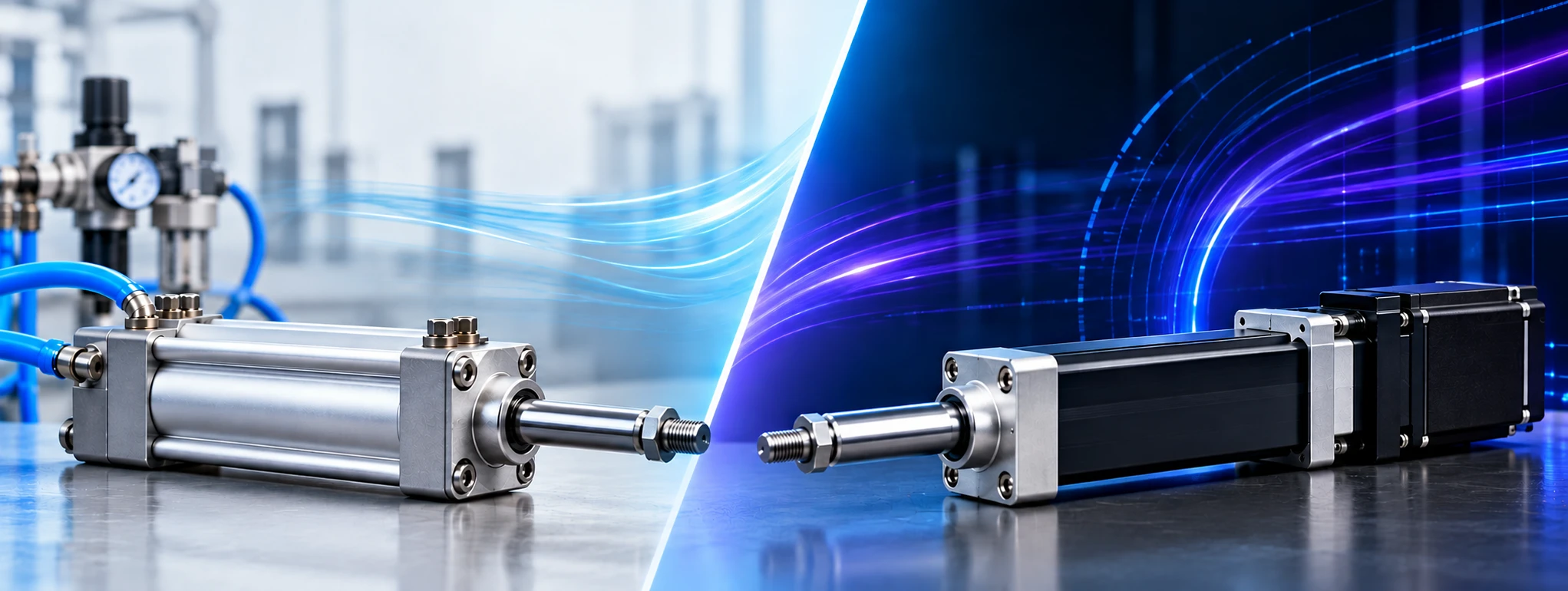
When a machine needs straight-line motion, one of the first design decisions is what powers it: compressed air or an electric motor. Both have a long history in industrial equipment. But machines today are asked to do more than push between two stops. They need to stop at several positions, report where they are, and fit into a networked control system. That is why more engineers now specify electric cylinders for new designs and retrofits.
This guide explains how the two technologies differ, where each one fits, and what to look for when you choose.

How each one works
A pneumatic cylinder uses compressed air to move a piston through a bore. Speed and force depend on air pressure, flow, and the load.
An electric cylinder, also called an electro-mechanical cylinder, converts motor rotation into linear motion with a lead screw or ball screw. The motor and its controller set position, speed, and force directly.
Where pneumatic still fits
Pneumatic cylinders are a reasonable choice for simple, fast moves between two fixed end points, especially when compressed air is already available and precision is not critical. If a part only needs to be pushed or clamped and then released, air can do the job at a low upfront cost.
Why electric is the better fit for precision motion
- Reason 1: Stop anywhere in the stroke. A pneumatic cylinder naturally travels between two end positions, and adding intermediate stops usually takes extra hardware. An electric cylinder can move to any position within its stroke, and those positions can be changed in software. On Helix captive electric cylinders with a smart motor, microstepping is configurable up to 51,200 steps per revolution, so the motor can position in very fine increments.
- Reason 2: Control over speed and force. Compressed air is compressible, which makes smooth motion and precise force hard to hold across a stroke. With an electric cylinder, the motor and drive set speed, acceleration, and force directly. Smart motor versions also offer programmable run and hold currents, so you can tune how much current the motor draws while moving and while at rest.
- Reason 3: Accuracy you can specify. Helix cylinders use rolled thread screws held to within plus or minus 0.0003 inch per inch of lead error. Anti-backlash lead screw nuts remove backlash entirely, and reduced-backlash ball nuts hold it to 0.001 inch, which matters when the load reverses direction.
- Reason 4: Feedback that confirms position. Optional encoders are available from 200 to 2000 counts per revolution, along with an optional linear potentiometer. Magnetic position sensors with repeatability up to plus or minus 0.004 inch (0.1 mm) mount directly on the cylinder, are field adjustable, and carry an IP67 rating. The controller knows where the rod is instead of assuming.
- Reason 5: Direct integration with modern controls. Smart motor versions support Ethernet TCP/IP (including Profinet, EtherNet/IP, and Modbus TCP), CANopen, and RS-422/485. They run on 12 to 48 VDC (NEMA 17) or 12 to 60 VDC (NEMA 23), and an optional IP65 rating with M12 connectors is available.
- Reason 6: Less infrastructure to maintain. A pneumatic axis depends on a compressor, air lines, filters, and regulators, and leaks anywhere in that system waste energy quietly. An electric cylinder needs power and a control signal.
- Reason 7: Enclosed and clean. The sealed tubular enclosure shields the screw from dust and dirt. Lead screw versions use a 300 series stainless steel screw with Helix H10X dry coating for smooth, quiet motion, and the cylinder housing is rated for operation from -20°F to +250°F with the factory-supplied grease (motor limits are separate).
A note on duty cycle
Some of the electrical energy going into an electric cylinder becomes heat, and the cylinder’s ability to dissipate that heat limits how continuously it can run. Helix lists approximate allowable duty cycles of 85 percent for ball screw versions and 25 percent for acme (lead screw) versions.
For continuous or high-cycle applications, a ball screw cylinder is the better choice. For intermittent positioning, a lead screw cylinder is a cost-effective option. Treat duty cycle as a design input from the start, not an afterthought.
Quick comparison
- Positioning: A pneumatic cylinder has two end positions, with extra hardware needed for more. An electric cylinder moves to any position within the stroke.
- Speed and force: Pneumatic speed and force depend on air pressure and flow. Electric speed and force are set by the motor and drive.
- Feedback: Pneumatic systems rely on add-on sensors. Electric cylinders offer encoders, a potentiometer, and magnetic sensors.
- Control integration: Pneumatic systems use valves and discrete I/O. Electric cylinders offer networked options such as EtherNet/IP, Profinet, Modbus TCP, and CANopen.
- Infrastructure: A pneumatic system needs a compressor, air lines, filters, and regulators. An electric cylinder needs power and a control signal.
- Changing a setup: Pneumatic changes are mechanical adjustments. Electric changes are software settings.
- Duty cycle: Pneumatic cylinders are well suited to simple, repetitive cycling. For electric cylinders, duty cycle is a design input: about 85% for ball screw versions and 25% for lead screw versions.
How to choose an electric cylinder
Once electric is the right fit, five choices shape the cylinder you need.
- Screw type: Choose a lead screw drive when cost and simplicity matter and the motion is intermittent. Choose a ball screw drive for higher duty cycles and demanding applications.
- Motor size: Helix captive electric cylinders accept NEMA 17 motors (stroke up to 18 inches) or NEMA 23 motors (stroke up to 24 inches), in single or double stack lengths, in half-inch stroke increments.
- Lead: Shorter leads deliver more force and finer resolution. Longer leads deliver more speed. The force versus speed charts show the tradeoff by voltage and lead.
- Load type: Account for static, dynamic, and acceleration loads. If the cylinder may see compressive loads over a long stroke, check column strength, since a long screw can buckle below the cylinder’s nominal capacity. Side loads need a separate review with application engineering.
- Mounting and rod end: Options include foot, trunnion, clevis, and mounting plate mounts, with clevis, spherical, alignment coupler, and threaded rod ends.
Where electric cylinders are used
Helix linear actuators, including electric cylinders, serve life science equipment such as syringe pumps and in-vitro diagnostics, semiconductor equipment such as wafer elevators and vacuum chamber doors, printing and 3D printing systems, and security & defense applications such as pan-tilt-zoom cameras and automated gates. Chemical processing plants are also replacing air-driven valve control and tray indexing with electric motion.
Making the switch
Many electric cylinder projects are retrofits that replace an existing air-driven axis. Start by gathering the basics: total maximum thrust load, travel and orientation, optimal and minimum and maximum speed, cycles per time period, and the life you need. With those, application engineering can match a cylinder to the job.
Two practical details help avoid surprises. Each Helix electric cylinder is made to order for the travel length you specify, rather than pulled from stock. And we recommend adding 10 mm of overtravel to each end of your desired stroke.
Frequently asked questions
- Is an electric cylinder more precise than a pneumatic cylinder?
For positioning, generally yes. An electric cylinder’s position is set by motor steps and screw lead rather than by air pressure. Helix cylinders use rolled thread screws held to plus or minus 0.0003 inch per inch of lead error, with optional encoders for feedback.
- Can an electric cylinder replace a pneumatic cylinder in an existing machine?
Often, yes. Match the stroke, load, and speed, then choose a mount and rod end that fit the existing machine. Helix offers foot, trunnion, clevis, and mounting plate mounts, and application engineering can help with the match.
- What duty cycle can an electric cylinder handle?
Helix lists approximate allowable duty cycles of 85 percent for ball screw versions and 25 percent for acme (lead screw) versions. Heat dissipation is the limiting factor.
- What information do I need to size an electric cylinder?
Total maximum thrust load, travel length and orientation, required speed, cycles per time period, and desired life. The Helix Stepper Motor Calculator can help narrow the motor and lead combination.
Ready to size an electric cylinder?
Use the Stepper Motor Calculator, download the Captive Electric Cylinders catalog, or contact the Helix application engineering team to talk through your load, travel, and duty cycle.
