
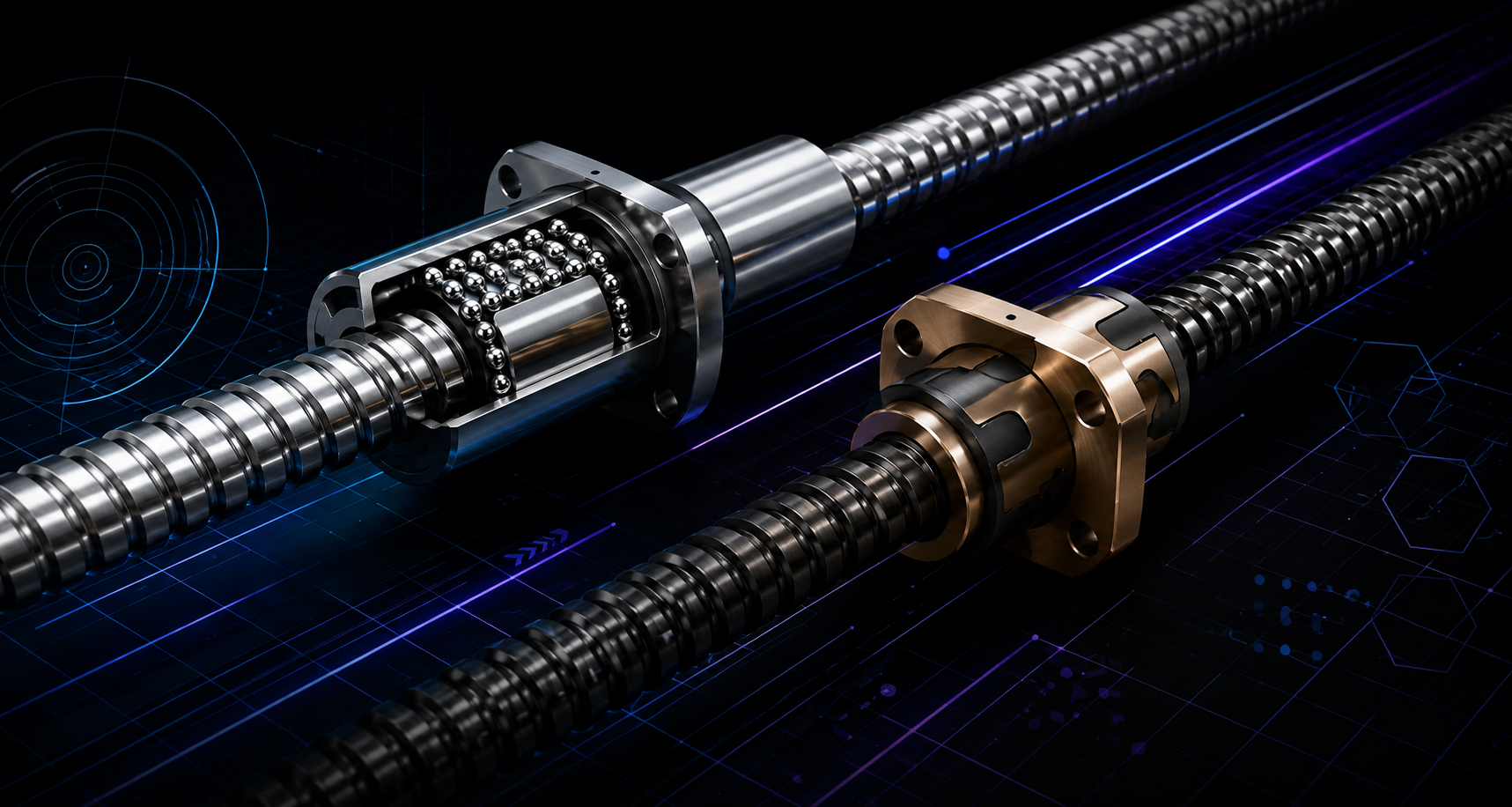
When it comes to converting rotary motion into linear motion, engineers have relied on two workhorse technologies for decades: ball screws and lead screws. Both use a threaded screw and a mating nut to translate rotation into linear movement, but the way they get there, and the applications they're best suited for, differ significantly. Understanding those differences is critical to specifying the right component for your design rather than defaulting to whichever one is more familiar.

The Core Difference: Rolling Friction vs. Sliding Friction
The fundamental distinction between the two technologies comes down to how the nut interfaces with the screw.
Ball screws use recirculating ball bearings that sit in the helical groove between the screw and the nut. As the screw rotates, the balls roll through the threads and recirculate through a return system, converting what would otherwise be sliding friction into rolling friction. This is mechanically similar in concept to a ball bearing supporting a rotating shaft.
Lead screws, by contrast, rely on direct thread-to-thread contact between the screw and nut. There are no balls or rolling elements involved. Movement happens through sliding friction, with the nut material (often an engineered polymer, though historically bronze, cast iron, or Babbitt-lined metal) sliding directly against the screw's threads.
That single difference, rolling versus sliding friction, drives nearly every other performance distinction between the two.
Efficiency and Power Requirements
Because ball screws minimize friction through rolling contact, they are considerably more efficient, typically in the 90% range, meaning less input torque is needed to move a given load. Lead screws, especially traditional Acme designs, are far less efficient, often in the 20 to 50% range depending on materials and lead angle. That means lead screw systems generally need more motor torque to move the same load compared to a ball screw system. This lower efficiency isn't necessarily a drawback though. In some applications, it's actually a design advantage (more on self-locking below).
Backlash and Precision
Ball screws can be manufactured with preload, which removes clearance between the balls and the threads and results in very low backlash. This makes them well suited to applications demanding high repeatability and positional accuracy, such as CNC machine tools and precision stages.
Lead screws can also be designed with preloaded, anti-backlash nuts, particularly with modern polymer nut designs. While they generally won't match the ultra-high precision of a ground, preloaded ball screw, a well-designed lead screw assembly can still deliver excellent accuracy and repeatability for a wide range of applications, often at a fraction of the cost.
Load Capacity and Speed
Ball screws typically support higher axial loads and can operate at higher speeds and duty cycles, which is part of why they dominate in heavy machine tool and industrial automation applications where sustained high-speed, high-load operation is the norm.
Lead screws are generally best matched to lighter to moderate loads and lower to moderate speeds and duty cycles. That said, advances in high-lead screw designs (originally developed to meet the speed demands of office printers and similar equipment) have expanded the performance envelope for lead screws considerably.
Self-Locking Behavior
This is one area where lead screw inefficiency becomes a feature rather than a limitation. Because lead screws rely on sliding friction, many lead screw and nut combinations are self-locking, meaning an axial load applied to the nut won't back-drive the screw. This is valuable in vertical lift or holding applications where you want the load to stay in place without continuous motor power or a separate brake.
Ball screws, being highly efficient by design, are generally back-drivable. An axial load can cause the screw to rotate unless the system incorporates a brake or the drive electronics are designed to hold position.
Noise and Vibration
Ball screws can be noisier in operation. The recirculating balls moving through the return mechanism and threads generate mechanical noise, which can be a consideration in office equipment, laboratory instruments, and other noise-sensitive environments.
Lead screws run quietly by comparison, especially modern designs using precision roll-formed screws and injection-molded polymer nuts. This is part of why lead screw technology became the preferred solution for high-speed office printers, where ball screws were ruled out early on due to noise.
Lubrication and Maintenance
Ball screws typically require grease lubrication to maintain performance and service life. That need for lubrication can be a real limitation in cleanroom, medical, semiconductor, food and beverage, and other environments where particulate contamination or lubricant migration is a serious concern.
Many modern lead screw nuts are self-lubricating, formulated with PTFE or other dry lubrication packages built directly into the polymer. This eliminates the mess and contamination risk of wet lubrication and makes lead screws a strong fit for cleanroom and hygienic applications where ball screws would need special sealing or alternative lubrication strategies.
Cost
Ball screws involve more precision components (hardened and ground raceways, recirculating ball systems, tight tolerances) which makes them more expensive to manufacture and purchase.
Lead screws, particularly those using precision roll-forming and engineered polymer nuts, are significantly more cost-effective to produce and purchase, which is a major reason they remain the go-to choice for cost-sensitive designs that don't require ball screw levels of load capacity or speed.
Typical Applications
Ball screws tend to show up in CNC machine tools, robotics, aerospace actuation, automotive steering systems, and other applications where high load, high speed, and high precision are non-negotiable.
Lead screws are common in office automation and printers, medical devices, laboratory and diagnostic equipment, semiconductor handling equipment, packaging machinery, and factory automation tasks where moderate load and speed requirements are paired with cost, noise, or cleanliness constraints.
Choosing Between Them
There's no universal "better" option between ball screws and lead screws. It comes down to matching the component to the application's requirements for load, speed, precision, environment, noise tolerance, budget, and whether self-locking behavior is a benefit or a hazard for your design. As with any linear motion component, Helix Linear Technologies supplies the ball screws and lead screws themselves, engineers building the end-use equipment are responsible for integrating the selected component into their complete system design.
| Characteristic | Ball Screws | Lead Screws |
|---|---|---|
| Friction Type | Rolling friction (recirculating balls) | Sliding friction (thread-to-thread contact) |
| Efficiency | High, typically around 90% | Lower, typically 20 to 50% |
| Precision & Backlash | Very low backlash with preload; ideal for high repeatability | Good precision achievable with anti-backlash nuts, generally less than ball screws |
| Load Capacity | Higher axial load capacity | Light to moderate loads |
| Speed & Duty Cycle | Higher speeds, higher duty cycles | Moderate speeds, though high-lead designs extend performance |
| Self-Locking | Generally back-drivable, may need a brake to hold position | Often self-locking, holds load without continuous power |
| Noise Level | Louder due to recirculating balls | Quiet operation |
| Lubrication | Requires grease lubrication | Many nuts are self-lubricating (PTFE and similar dry lubrication packages) |
| Cleanroom / Hygienic Fit | Less suited without special sealing due to grease | Well suited to medical, semiconductor, and food processing environments |
| Cost | Higher due to precision components | More cost-effective |
| Typical Applications | CNC machine tools, robotics, aerospace actuation, automotive | Office automation, medical devices, lab equipment, semiconductor handling, packaging |
If you have any questions about the type of screw and nut to use for your next project, reach out to the Helix Engineers. We are happy to help walk you through the process.
