

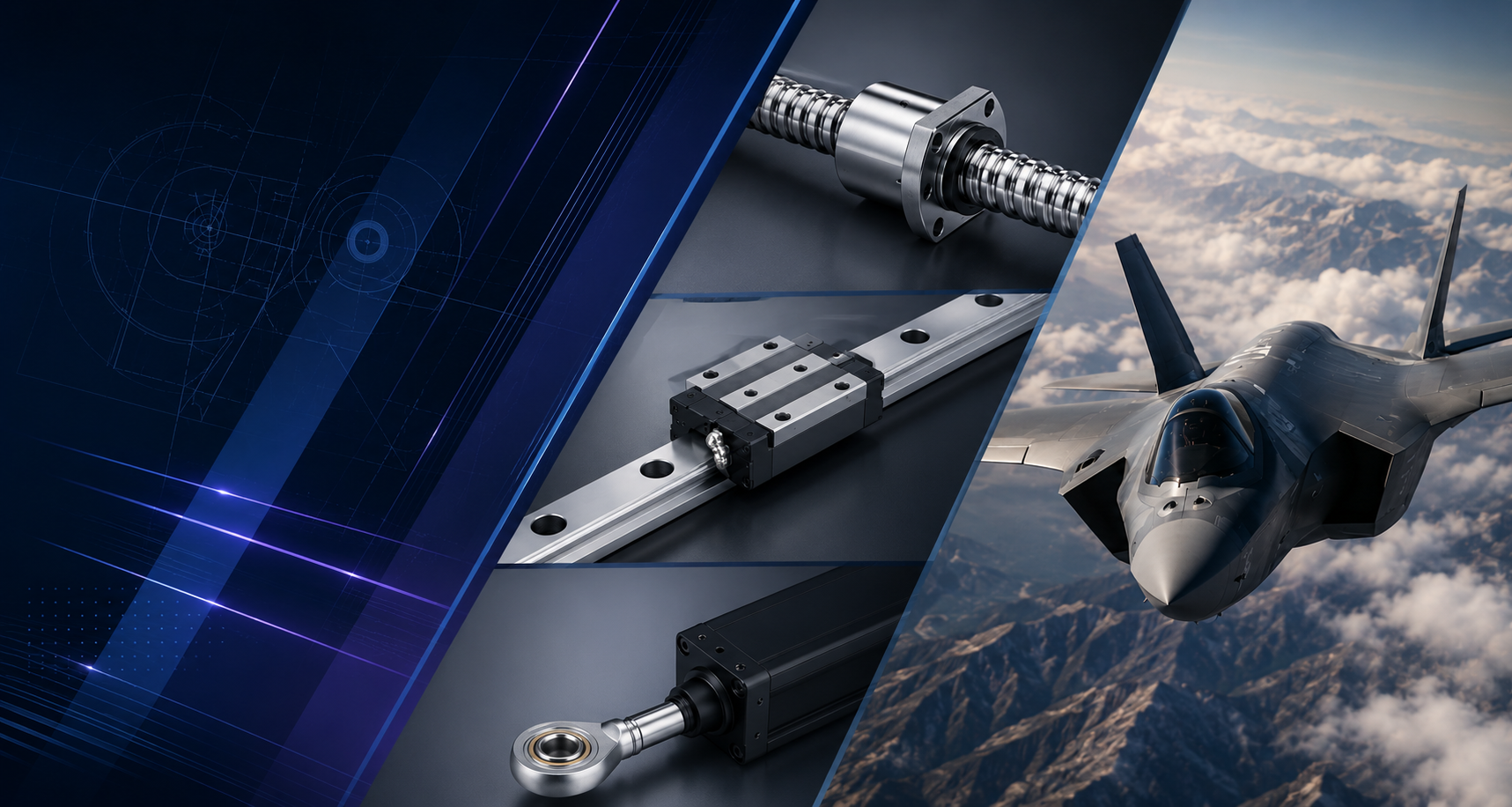
Audience: Design & Systems Engineers | Sector: Aerospace & Defense | Read Time: ~10 Min
Why Aerospace Is a Different Challenge
Linear motion systems are embedded throughout modern aerospace and defense platforms. These include flight control actuators, landing gear mechanisms, satellite positioning systems, missile guidance assemblies, and UAV payload gimbal drives. In each case, the margin for error is essentially zero.
Unlike industrial automation, aerospace applications demand performance under punishing environmental conditions, with extreme reliability over long service intervals, and within tightly constrained size and weight envelopes. Sourcing a screw or guide rail based purely on load rating is a fast path to specification failure.
This guide walks through the critical engineering factors that must inform component selection decisions for aerospace and defense linear motion systems.
1. Load Requirements: Beyond Static Ratings
Catalog load ratings tell you the static or dynamic capacity under idealized conditions. In aerospace, the actual loading profile is rarely that simple. Flight-induced vibration, launch shock, maneuvering loads, and thermal expansion all create dynamic force conditions that must be fully characterized before specifying a component.
Shock Loads
Shock loads are one of the most common failure mechanisms in aerospace linear motion systems. Landing events, separation events, and ballistic environments can introduce instantaneous peak forces that may be 10 to 50 times the nominal operating load. Your component must survive these events without permanent deformation or loss of function.
Combined Loading
Combined loading is the norm rather than the exception. Ball screws and lead screws operating in flight control or actuation systems often see simultaneous axial, radial, and moment loads. Always calculate the equivalent dynamic load using the full three-dimensional force vector, not just the primary axis.
Fatigue Life
Fatigue life must be rated against the full mission cycle count, not just peak operating conditions. A component experiencing 1 million cycles at modest load may fail sooner than expected if the loading is cyclically variable and includes high-stress excursions.
Engineering Note: Apply a safety factor of 2x to 4x beyond the calculated peak load for critical flight hardware. For single-point failure modes, consult your system FMEA and consider redundancy architecture.
2. Surviving the Environment
Aerospace environments are hostile by definition. A component that performs flawlessly on the lab bench may seize, corrode, fatigue, or degrade in service if environmental factors were not fully considered during selection.
Temperature Extremes
Operating temperature ranges for aerospace linear motion components can span from cryogenic (-65°C and below for space and high-altitude applications) to elevated temperatures exceeding +200°C in propulsion-adjacent systems. Thermal cycling causes differential expansion between dissimilar materials, which is a critical consideration for preloaded assemblies like recirculating ball screws.
Verify that the coefficient of thermal expansion (CTE) of the screw, nut, housing, and mounting structure are all compatible. Mismatch will alter preload, change backlash, and in worst cases cause seizure or component fracture.
Vacuum and Outgassing
For space applications, all materials and lubricants must comply with NASA ASTM E595 or equivalent outgassing standards. Organic lubricants, polymer seals, and certain coatings will off-gas in vacuum, contaminating optical sensors and thermal management surfaces. Specify dry-film lubricants, MoS2-based solid lubricants, or PFPE-based greases rated for vacuum service.
Vibration and Acoustic Loads
Launch environments expose components to broadband random vibration profiles up to 150 dB OASPL and sinusoidal sweep inputs per MIL-STD-810 or program-specific test requirements. Ball screw assemblies must be assessed for resonant frequency response. Natural frequency should be designed above the excitation band, or damping provisions must be added.
| Environment | Key Threat | Mitigation | Severity |
| Space / Vacuum | Outgassing, cold weld | PFPE lube, MoS2 coating | Critical |
| High Altitude / Airborne | Thermal cycling, humidity | Sealed assemblies, CTE matching | Critical |
| Maritime / Naval | Salt fog corrosion | 316 SS, hard anodize, IP sealing | High |
| Ground / Tactical | Contamination, dust, shock | Sealed wipers, shock isolators | Medium |
| Radiation (Space) | Material degradation | Rad-hardened materials, shielding | Critical |
3. Precision, Accuracy & Repeatability
The precision requirements for a structural deployment latch are radically different from those for a fine-pointing mirror actuator or a laser targeting drive. Before specifying a component, quantify your application's accuracy, repeatability, and backlash tolerance.
Lead Accuracy and Lead Error
Ball screws are classified by lead accuracy grade per ISO 3408 or DIN 69051. For high-precision positioning (sub-10 µm), specify Grade 3 or better. For actuation where position is closed-loop controlled via a separate encoder, Grade 5 or 7 may be acceptable and will save cost and weight. Never assume catalog grade without verifying it against your position error budget.
Backlash
Backlash is the deadband of lost motion when direction reverses. In flight control and guidance applications, even a few arc-seconds of angular error from linear backlash can translate to significant pointing error downstream. Preloaded ball screw nuts or anti-backlash lead screw nuts eliminate mechanical deadband, though at the cost of higher friction and thermal generation.
Stiffness
Axial stiffness of the lead or ball screw assembly must be adequate to resist the application's load without yielding positional error under load. Stiffness is a function of screw diameter, lead, ball circuit geometry, preload, and unsupported length. Slender long-travel screws on vertical axes under gravity load are a common source of unexpected positional drift.
Common Specification Error: Engineers frequently specify component accuracy without accounting for the full error budget. Thermal drift, mounting deflection, bearing runout, and motor encoder resolution all contribute. Model the complete error chain before establishing component-level accuracy requirements.
4. Material Selection & Surface Engineering
Material selection for aerospace linear motion components is a systems-level decision that integrates strength, weight, corrosion resistance, compatibility with lubricants and coatings, and compliance with export and program material specifications.
Screw and Rail Body Materials
High-alloy bearing steels (52100, 440C stainless) are the workhorse for ball screw and recirculating ball rail systems. 440C offers good corrosion resistance in addition to high hardness. For extreme corrosion environments, nitronic or precipitation-hardened stainless alloys may be required. Titanium is used where mass is critical, though tribological performance requires careful surface treatment.
Coatings and Surface Treatments
Hard chrome plating has historically been a go-to surface treatment for corrosion and wear resistance, but it is increasingly regulated under REACH and equivalent directives. Alternatives include HVOF thermal spray coatings, hard anodize for aluminum components, DLC (diamond-like carbon) for low friction in dry or vacuum environments, and various PVD nitride coatings for hardness.
Dissimilar Metal Galvanic Compatibility
Galvanic corrosion between dissimilar metals is a common failure mode in aerospace assemblies exposed to moisture or salt fog. Always verify the galvanic potential difference between the linear motion component and its housing, mounting hardware, and mating interface. Use isolation bushings, anodized interfaces, or barrier coatings to prevent electrochemical attack.
5. Mass Budget & Envelope Constraints
In aerospace, mass is a primary design currency. Every gram of linear motion hardware displaces payload, fuel, or structural margin. A screw assembly that meets all functional requirements but exceeds its mass allocation by 20% may require a complete redesign iteration.
Designing to Mass Budget
Work from the top down: establish the component-level mass allocation early based on the subsystem and vehicle mass budget. Use this allocation to drive material selection. Choose titanium over steel where loads permit, hollow screws where torsional stiffness allows, and aluminum-body linear guides with steel raceways for rail systems.
Packaging Constraints
Envelope constraints in aerospace vehicles are typically non-negotiable because the system is designed around fixed structural geometry. Verify flange-to-flange dimensions, shaft extension lengths, clearance radii for nut rotation, and travel limits including over-travel protection before completing the mechanical interface.
Lead Selection and Mechanical Advantage
Lead selection affects both physical packaging and actuator sizing. A coarse lead reduces the torque required from the drive motor, which saves actuator mass, but it also reduces the available thrust force for a given torque input. A fine lead delivers higher thrust but requires higher input speed. Consider the full electromechanical efficiency chain, not just the mechanical transmission ratio.
6. Reliability, Life, and Failure Mode Analysis
Aerospace procurement is not simply about finding a component that works. It is about finding a component with a quantifiable, predictable service life and known failure modes that can be managed through design, redundancy, and maintenance intervals.
Rating Life (L10)
The L10 bearing/screw life is the number of revolutions (or hours) at which 90% of a population of identical components will still be in service. For safety-critical aerospace applications, L10 life alone is insufficient. You must verify that the reliability target (e.g., 99% survival at service life) is achieved under the full mission loading spectrum, including all off-nominal conditions.
Failure Mode and Effects Analysis (FMEA)
Map the failure modes of your linear motion component against the system-level consequences. These failure modes include jamming, seizure, excessive wear, loss of preload, and nut separation. For flight-critical functions, single-point failures must be designed out or mitigated through redundancy. Helix Linear Technologies can provide detailed DFMEA support data for program-level reliability analyses.
Maintenance and Inspection Access
For applications with defined maintenance intervals, design for inspectability. Can the linear assembly be removed and inspected without removing surrounding structure? Is there a grease fitting or lubrication port accessible on-wing or on-vehicle? What are the diagnostic indicators of impending failure, such as elevated friction, audible noise, or measurable backlash growth?
Reliability Requirement: Typical aerospace reliability targets for flight-critical actuators range from 0.9999 to 0.999999 per mission. Translate this into a component-level reliability requirement through your reliability apportionment model before specifying life.
7. Lubrication Strategy
Lubrication is frequently treated as an afterthought in linear motion component selection, and this oversight is responsible for a disproportionate share of in-service failures. In aerospace applications, lubrication strategy is a design decision, not a maintenance task.
Lubricant Selection by Environment
Standard petroleum-based greases perform acceptably in ground-level, moderate temperature environments but are unsuitable for cryogenic, vacuum, or high-temperature aerospace service. PFPE (perfluoropolyether) greases offer a broad temperature range and low outgassing, making them the standard for space applications. MoS2 solid film lubricants are preferred for vacuum service where liquid lubricants would evaporate or cold-weld.
Lube Life and Reapplication
Estimate lubricant life based on the contact stress, sliding speed, temperature, and number of cycles. For sealed-for-life applications common in inaccessible aerospace mechanisms, the lube reservoir must outlast the design service life with margin. Overlubrication can be as damaging as underlubrication. Excess grease in a ball screw can cause churning losses, seal failure, and contamination.
Dry Film and Coated Options
For mechanisms operating in cleanrooms, vacuum chambers, or other environments where lubricant contamination is unacceptable, dry-film coated screws and rails (PTFE, MoS2, tungsten disulfide) provide a sacrificial low-friction layer without liquid lubricants. These options have finite wear life and require careful cycle count tracking.
8. Standards, Certification & Compliance
Aerospace procurement operates within a framework of quality standards, regulatory requirements, and customer-specific specifications that directly constrain which components and suppliers are acceptable for a given program.
Quality Management: AS9100
AS9100 Rev D is the baseline quality management system requirement for aerospace supply chains. Suppliers manufacturing linear motion components for aerospace programs should be AS9100 certified. This certification provides assurance that design, manufacturing, inspection, traceability, and nonconformance processes meet aerospace-grade standards. Helix Linear Technologies operates under AS9100 certification for applicable product lines.
Military Specifications
Defense programs frequently invoke MIL-SPEC requirements for components, including material specs (MIL-DTL, MIL-A), testing requirements (MIL-STD-810 for environmental, MIL-STD-461 for EMC), and qualification procedures. Confirm that your linear motion supplier can provide test data and certifications traceable to the applicable MIL documents required by your program.
ITAR and Export Compliance
Many defense linear motion applications involve ITAR-controlled technology. Ensure your supplier maintains appropriate export compliance infrastructure, that foreign national access to design and manufacturing data is controlled, and that hardware destined for export is covered by the appropriate license or license exemption. This is a legal obligation, not merely a program formality.
First Article Inspection and PPAP
For production programs, require First Article Inspection (FAI) per AS9102 and a Production Part Approval Process (PPAP) or equivalent to ensure that production units conform to design intent. Dimensional reports, material certifications, functional test data, and process capability data should all be established before production release.

Engineer's Selection Checklist
Use this as a starting framework when beginning a linear motion component selection for aerospace and defense programs:
- Define peak, nominal, and fatigue load cases across all axes (axial, radial, moment)
- Characterize the shock and vibration environment per applicable MIL-STD or launch vehicle ICD
- Establish operating temperature range and thermal cycling profile
- Determine vacuum, humidity, salt fog, or other special environmental exposures
- Quantify positional accuracy, repeatability, and allowable backlash requirements
- Calculate the complete error budget, not just the component-level accuracy spec
- Verify screw/guide lead accuracy grade against ISO 3408 or applicable standard
- Identify material requirements including outgassing compliance for space applications
- Check galvanic compatibility of all mating materials in the assembly
- Establish the component-level mass allocation before specifying materials
- Calculate L10 life under the full mission load spectrum and apply appropriate reliability margin
- Define lubrication type, quantity, and reapplication interval (or sealed-for-life strategy)
- Verify supplier AS9100 certification and applicable MIL-SPEC qualification data
- Confirm ITAR compliance requirements and supplier export controls
- Plan for First Article Inspection and production qualification testing
- Identify failure modes, map against system FMEA, and address single-point failures
Build It Right the First Time
Linear motion component selection for aerospace and defense is a multi-dimensional engineering discipline. Load ratings are the starting point, not the finish line. Environmental compatibility, material selection, precision requirements, lubrication strategy, mass management, and regulatory compliance all intersect in a way that demands careful, systematic analysis.
The cost of getting it right at the specification stage is measured in engineering hours. The cost of getting it wrong is measured in test failures, redesign cycles, program delays, and potentially mission loss.
Helix Linear Technologies partners with aerospace and defense engineers from early concept through production qualification. We provide component data, application analysis, and custom solutions for the industry's most demanding motion challenges. If you are working through a linear motion selection challenge, our engineering team is ready to support your program.
Engineering Resources | All Technical Specifications Subject to Change